
 Photo: Canva
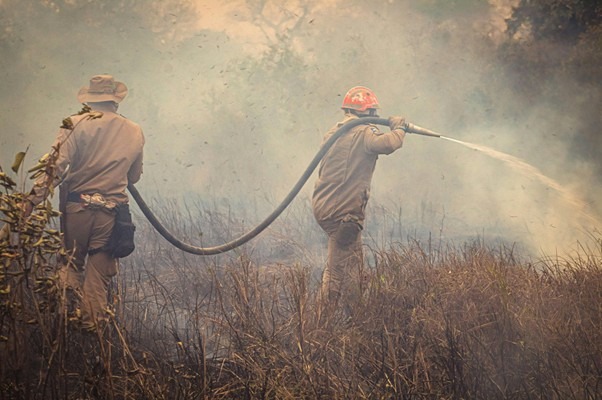
Every year, wildfires affect large areas of Spain, putting communities and public health at risk. With wildfires currently affecting several parts of Spain, it is important to recognize the health risks posed by wildfire smoke and take steps to limit exposure.
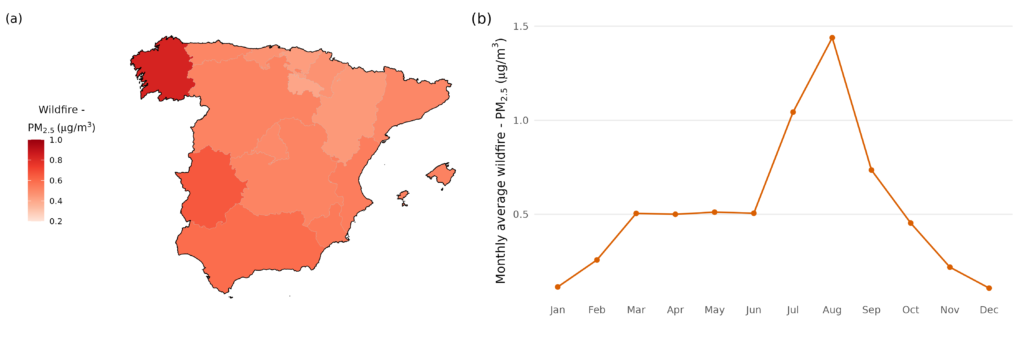
Across Spain, some regions experience consistently higher wildfire-related PM₂.₅ concentrations than others. The highest annual average concentrations are found in Galicia, Extremadura, the Valencian Community, Murcia, and Andalusia (Figure 1a). Wildfire-related PM₂.₅ exposure exhibits a clear seasonal pattern, increasing during the summer months. Average concentrations reach their highest values in July and August (Figure 1b).
Source: System for Integrated Modeling of Atmospheric Composition (SILAM). Figure developed by authors.
Figure 1: Spatial and temporal patterns of wildfire-PM₂.₅ exposure in Spain from 2003 to 2025. (a) Annual average Wildfire PM₂.₅ (µg/m³) in Spain; (b) Monthly average Wildfire PM₂.₅ (µg/m³) in Spain.
When Wildfires Burn, Health Suffers
Wildfire occurrence depends on the source of ignition, while meteorological conditions and fuel loads strongly influence fire spread, intensity, and duration. Although wildfires are a characteristic feature of Mediterranean ecosystems, their frequency and severity have increased in recent years. Rising temperatures and more frequent droughts associated with climate change are further exacerbating wildfire risk, highlighting the growing challenge of reducing both fire occurrence and the associated health impacts.
Exposure to wildfire smoke has important health consequences, particularly in the short term, although evidence on its cumulative long-term effects is still emerging. Wildfire smoke is a complex mixture of gases and fine particles, making it potentially more harmful than air pollution from many other sources. It contains fine particulate matter (PM₂.₅), carbon monoxide, nitrogen oxides, volatile organic compounds, and other harmful pollutants, with its composition depending on the fuels being burned and combustion characteristics. Consequently, the toxicity of smoke can differ substantially between fires, influencing the severity of respiratory and cardiovascular health effects.
A 2025 study conducted as part of the CATALYSE Horizon Europe project led by ISGlobal found that wildfire smoke has a greater impact on mortality risk than air pollution from other sources. Between 2004 and 2022, short-term exposure to wildfire smoke was associated with an estimated 535 deaths each year across Europe. Assuming wildfire smoke was equally harmful as particles from other sources would have underestimated the number of deaths by 93%.
The most common health effects involve the cardiovascular and respiratory systems, with children, older adults, pregnant women, and people with pre-existing health conditions being the most vulnerable populations. Beyond these physical health impacts, wildfires can also affect mental well-being through evacuation, displacement, property loss, prolonged uncertainty, and anxiety associated with the event, with some individuals experiencing long-lasting psychological consequences.
Protecting Your Health During Wildfire Smoke Events
Given these health risks, taking preventive measures during wildfire events is essential to reduce exposure and protect your health. Official recommendations on how to protect yourself during a wildfire event from the Spanish Ministry of Health include:
- Stay indoors when possible and keep windows and doors closed to reduce smoke exposure.
- Stay well hydrated and avoid alcohol and caffeine.
- Wear an FFP2 or N95 respirator when recommended. Surgical and cloth masks do not provide adequate protection against fine particles.
- Follow updates and guidance from official public health and emergency authorities.
- More recommendations on how to protect yourself during wildfire event, consult the Spanish Ministry of Health’s official guidance.
Author:

Julia Placido Moore is a predoctoral research fellow at the Barcelona Institute for Global Health (ISGlobal), Barcelona, Spain. With a background in air quality and environmental health, her doctoral research focuses on the health impacts of wildfires in Europe.

 This Project receives funding from the European Union’s Horizon Europe research and innovation programme under Grant Agreement number: